
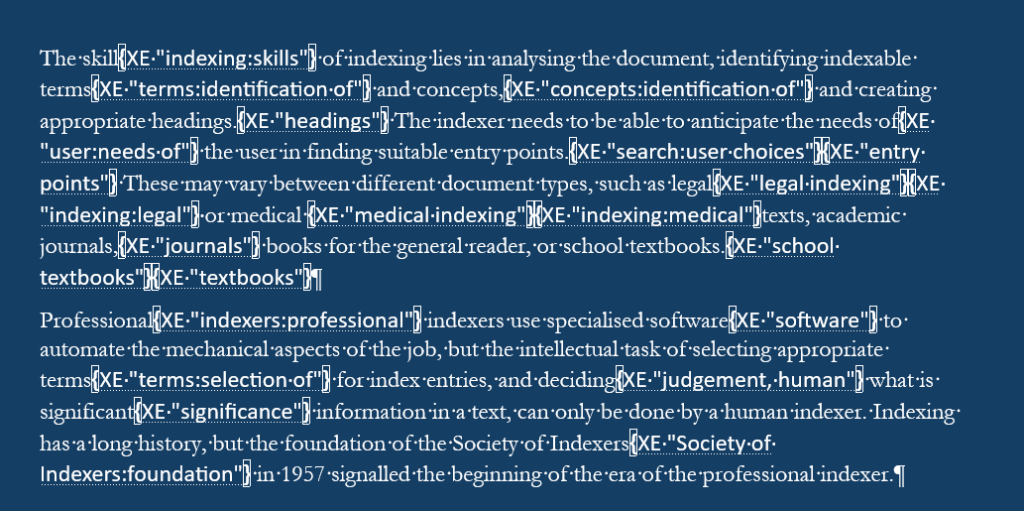
While most indexes are still compiled from page proofs, some indexes are embedded, where the index entries are added as tags or codes to a manuscript file. In this blog post Tanya Izzard – who actually enjoys embedded indexing – explains how the process works and when clients might need or want to use embedded indexing for their project.
Embedded indexing: how does it work?
Word, InDesign and other XML editing programmes all allow indexes to be created within a document file by adding tags, or codes to the file. The codes contain the words that will appear in the index as a heading; the indexer adds them directly into the text. These indexing tools all allow indexers to create page spans and cross-references, too.
Once all the entries have been coded into the document, the index is generated. All the headings created as codes then appear as index headings, and the correct page numbers or page spans are automatically be inserted. Duplicate page numbers are suppressed, and the index is sorted in alphabetical order.
Embedded indexing is usually carried out earlier in the publishing workflow than traditional indexing. Ideally, texts will have been copyedited before submission for indexing, but this is not always the case. When indexing in Word, it is likely that the publisher will import the manuscript into a typesetting system; the index codes created will transfer across with the text. When indexing in InDesign, the book will already have been typeset.
Embedded indexing: what are the benefits and disadvantages?
There are several benefits to embedded indexing. Firstly, it can save time in the publishing workflow.
It is particularly valuable in books that will be updated frequently, such as annual guidebooks, and in books that will be published in different formats, as the index can be refreshed to account for the change in format or page size. This is very useful for books that will be published in hard copy and as eBooks.
For eBooks and books that will be published as PDFs, embedding allows the creation of active, hyperlinked indexes. Hyperlinked indexes make eBooks much more accessible to index users.
However, there are also disadvantages. Consistency in wording is needed for the index to form correctly, and automated features in Word and InDesign tend to generate unhelpful long strings of locators. So it can be easy to introduce errors.
The indexing process can take a little longer: each time an indexer makes an embedded entry, they have to decide precisely where to put it. For this reason, embedded indexing can be more expensive. Most indexers specialising in embedded indexing will charge a higher rate for this type of work. There are fewer indexers specialising in this work, so there is a reduced choice of indexers to undertake a project. It’s even more important to book early if you need an indexer for an embedded index.
Because the indexer will be working in the live document file, there is a risk of introducing errors or inadvertent changes. Professional indexers will have systems for preventing this, however. And the index will still need checking to ensure that all relevant topics have been picked up.
Embedded indexing: how indexers work
Both Word and InDesign have inbuilt indexing tools. They can be slow to use, both when building the index and editing it.
However, most professional indexers will use some form of indexing software in their work, and these can be used to create embedded indexes, which allows them to work much more quickly. As for standard indexing from page proofs, indexers will bring their professional skills to bear on any project, ensuring the final index meets the publisher’s requirements, takes account of the needs of readers and the content of the book, and improves the accessibility of information for index users.
Next steps
How can you find out if an embedded index is required for your book? Some publishers, especially in the academic and scholarly publishing sector, require embedded indexing. Authors should check what type of index is required when they submit their book proposal; it is always easier to find an indexer in advance.
Self-publishing authors whose book will be an eBook, or published as a PDF, will also benefit from an embedded index.
If you need to find an embedded indexer, our Professional Directory provides a filtered list of embedding specialists – filter further on your subject specialism as required. If you want to learn more about embedded and eBook indexing, our workshop Active Indexing gives an overview of eBook production and indexing processes.
About Tanya Izzard
Tanya Izzard indexes scholarly and trade books in the humanities, producing standard and embedded indexes for authors and publishers. She has been indexing full-time since 2017 and is an Advanced Professional Member of SI and the Marketing Director on the SI Executive Board. The image is a screenshot of embedded index codes in a Word document.
AI Artificial Intelligence Ask the Indexers authors as indexers automated indexing Awards Becoming an indexer Biography indexing books of the year Client feedback Commissioning an indexer computers and indexing conferences cost management difficult texts embedded indexes honorary president Indexers indexes indexing indexing careers Indexing names Index quality Membership national indexing day networking passing mentions politics of indexing portfolio jobs project tracking reference sources self-indexing self publishing Society of Indexers time management Training as an indexer Working with authors